Friday, November 18, 2011
Chapter 8
Chapter 8 talks about the formulation of arguments for presentation purposes. The information in this chapter is pertinent to our multi-modal project in that it will help us make our arguments as well as form our rhetorical perspectives to help push our argument. Different decorum work for different purposes, such as academic versus public presentations. Academic works, such as the multi-modal assignment, should be presented in either a grandiose fashion or a formal fashion. The grandiose style of argumentation is used seldomly, and only for highly academic papers, such as different term papers, research papers, and at the request of teachers or superiors. The formal style of writing is used for most academic papers, as it is shows that you have a mastery of the topic at hand. With the final style of writing, the plain style, is mostly for informative purposes, as it tailors to an audience that is not familiar with the subject at hand. With all of these methods of writing, the multi-modal project can be tailored to whatever audience we are presenting to. This chapter also talks about the use of rhetorical devices used in order to shape the argument throughout the course of the presentation. Images and word choice are important parts of the rhetorical aspect of these writing styles. By using these rhetorical devices, it is possible to shape the argument of the multi-modal project to suit the purpose claimed by the group as a whole. In the use of these styles of writing and the rhetorical devices, even the most intricate nuances of the group's argument can be accurately explained.

Tuesday, October 25, 2011
The Past is the Present
When making decisions, one can only rely on what he or she has experienced (disregarding communication through society). Mary cannot make a decision based on what Alice knows without Alice telling Mary what happened. Based on this limitation, one can safely assume that any choice is based off of experiences in one’s past. When one considers this, it brings a whole new light to the term “The past determines the future.” As we live out our early lives, our young minds are conditioned by our experiences. Some people are conditioned to like certain activities, and others are likewise conditioned to appreciate other activities. In the same matter, our views on society are marginally influenced by our pasts. Different factors, like parenting, hate crimes, and many other things can all have an effect on what we believe later on in life, and how we view the world around us.
For example, take two intellectual twins. If one grows up in the slums of one of the world’s biggest cities, he will be inclined to appreciate what he has, rather than wanting for more than he deserves. However, if his intellectual twin were to have a life settled in the pleasant country, thriving on a millionaire’s budget, his views of materialism might be a little less stringent than his counter-part’s. On the whole, we can apply this to nearly all facets of society and perspectives in general. When a child grows up being the victim of hate crimes, he is being conditioned, one way or another, to believe one thing or another. If a child grows up with Republican parents all his life, he is going to be inclined to view the Republican side of any argument to be the most logical, because they hearken back to the methodology of the problem that their parents instilled in them while they were young.
Granted, if someone were to completely detach themselves from the problem and look at it objectively, meaning that all past experiences were rendered null in the deciding of the problem, then it is possible that the past of a person could not influence the decisions that are being made in the present. After all, even though the past is a significant factor in our present decisions, it, by no means, sets our choices in stone.
Wednesday, October 19, 2011
Annotated Bibliography
Jackson Stagg
Farrelly, Maura. "God is the Author of Both." American Society of Church History. 77.03 (2008): 659-87. Web. 13 Oct. 2011. <http://journals.cambridge.org/action/displayFulltext?type=1&fid=2163752&jid=CHH&volumeId=77&issueId=03&aid=2163744&bodyId=&membershipNumber=&societyETOCSession=>.
In this excerpt, Maura Farrelly expertly explains how science does not necessarily disprove theism. In fact, throughout her argument, and with many outside citations, she proves that there are many aspects of science that actually prove theism.
Savino, Damien. "Atheistic Science: The Only Option?" Logos: A Journal of Catholic Thought and Nature. 12.04 (2009): 56-71. Web. 13 Oct. 2011. <http://muse.jhu.edu/journals/logos/v012/12.4.savino.html>.
With his rational thinking and logical citations, Damien Savino provides intellectual dissertations on many atheistic and theistic aspects, providing wide-held views coupled with his own, as well as explaining many other views held on the topics at hand.
Markham, Ian. "Against Atheism: Why Dawkins, Hitchens, and Harris are Fundamentally Wrong." Ars Disputandi. 11. (2011): n. page. Web. 18 Oct. 2011. <http://www.arsdisputandi.org/publish/articles/000377/article.pdf>.
Ian Markham discusses the New Atheist movement, especially 3 of the foremost atheists in the group. Over the course of the article, he explains the viewpoints of these atheists, and counters them with others’ viewpoints or his own.
Goodrum, Matthew. "Atomism, Atheism, and the Spontaneous Generation of Human Beings: The Debate over a Natural Origin of the First Humans in Seventeenth-Century Britain." Ars Disputandi. 63.2 (2002): 207-224. Web. 18 Oct. 2011. <http://muse.jhu.edu/login?uri=/journals/journal_of_the_history_of_ideas/v063/63.2goodrum.html>.
This article is a purely factual one. It explains the beliefs held by Atheists and Atomists alike, and these facts will help me form my argument by concretely understanding the viewpoint of atheists.
"Atheism: Common Arguments." infidels.org. N.p., 1997. Web. 18 Oct 2011. <http://www.infidels.org/library/modern/mathew/arguments.html>.
This source is an encyclopedia of sorts to understand common atheistic arguments. With these, I will be able to formulate counter-points for many diverse atheistic arguments.
"Arguments Against God: Atheological Arguments for Atheism and Against the Existence of God." About.com. N.p., n.d. Web. 18 Oct 2011. <http://atheism.about.com/od/argumentsagainstgod/Arguments_Against_God_Atheological_Arguments_for_Atheism.htm>.
This article is also a faux encyclopedia of atheistic arguments with which to research and obtain counter-points for, thus strengthening my argument.
Craig, William, and Walter Sinnott-Armstrong. "God? A Debate Between a Christian and an Atheist." Ars Disputandi. 4. (2004): n. page. Web. 18 Oct. 2011. <http://www.arsdisputandi.org/publish/articles/000163/article.pdf>.
A scholarly debate between a Christian and an Atheist will provide first-hand knowledge on viewpoints and counter-points alike for both Christian and Atheistic arguments.
Perkins, R. "An Atheistic Argument from the Improvability of the Universe." Nous. 17.2 (1983): 239-250. Web. 19 Oct. 2011. <http://www.jstor.org/stable/2215144>.
This article is a scientific view of the statistics that make up the universe, and how they support atheistic views.
Lorca, Daniel. "A Critique of Quentin Smith's Atheistic Argument from Big Bang Cosmology." Philosophy. 70.271 (1995): n. page. Web. 19 Oct. 2011. <http://journals.cambridge.org/action/displayAbstract;jsessionid=3788BAEC358DF546FB5A64934AA337FA.journals?fromPage=online&aid=3497960>.
Daniel Lorca uses prominent scientific atheist Quentin Smith’s argument from “Big Bang Cosmology” in order to point out critiques in the atheistic viewpoint.
Collins, Robin. Traditional Arguments for the Existence of God. Sixth. Wadsworth: Cengage Learning, 2003. 202-219. eBook. <http://books.google.com/books?hl=en&lr=&id=Lj1sucLzZmUC&oi=fnd&pg=PA202&dq=atheistic arguments&ots=lBAtsSD4sn&sig=C5GnYjf64hjVlDXP1gbbt3Rmkhs
This source will be a faux encyclopedia for Arguments that support Theism, and will help strengthen my argument with appropriate citations.
Smith, Quentin. "Swinburne's explanation of the universe." Religious Studies. 91-102. Web. 19 Oct. 2011. <http://www.jstor.org/stable/20008142>.
Quentin Smith, a foremost scientific atheist, takes a look at Swineburne’s explanation of the universe, and discusses the points behind it pertaining to the spiritual plane.
Clements, Tad. Science vs. Religion. 1st. New York: Prometheus Books, 1990. Print.
Tad Clements, in his work “Science vs. Religion”, explains why science does not necessarily disprove a theistic viewpoint, and in some cases, discovers why scientific and empirical evidence supports the claims for theism.
Thursday, September 22, 2011
http://www.arsdisputandi.org/publish/articles/000163/article.pdf
The preceding is an argument between an atheist and a christian, and contains many Atheistic arguments, as well as their christian counter-points.
http://muse.jhu.edu/journals/journal_of_the_history_of_ideas/v063/63.2goodrum.html
This link contains a look at the atheistic and atomistic views on spontaneous generation of human beings.
http://www.infidels.org/library/modern/mathew/arguments.html
This link is a library which documents quite a few well known atheist viewpoints, as well as counterpoints found by the theistic public in order to disprove them.
http://atheism.about.com/od/argumentsagainstgod/Arguments_Against_God_Atheological_Arguments_for_Atheism.htm
This link is another library for atheistic arguments that can easily be accessed.
http://www.arsdisputandi.org/publish/articles/000377/article.pdf
This link contains a PDF which looks at a few atheists who are part of the New Atheist Movement, their arguments, and theistic counterpoints.
The preceding is an argument between an atheist and a christian, and contains many Atheistic arguments, as well as their christian counter-points.
http://muse.jhu.edu/journals/journal_of_the_history_of_ideas/v063/63.2goodrum.html
This link contains a look at the atheistic and atomistic views on spontaneous generation of human beings.
http://www.infidels.org/library/modern/mathew/arguments.html
This link is a library which documents quite a few well known atheist viewpoints, as well as counterpoints found by the theistic public in order to disprove them.
http://atheism.about.com/od/argumentsagainstgod/Arguments_Against_God_Atheological_Arguments_for_Atheism.htm
This link is another library for atheistic arguments that can easily be accessed.
http://www.arsdisputandi.org/publish/articles/000377/article.pdf
This link contains a PDF which looks at a few atheists who are part of the New Atheist Movement, their arguments, and theistic counterpoints.
Monday, September 19, 2011
2 Ideas for a Research Paper
1. The flaws in arguments for common scientific and natural atheism arguments.
2. The many changes in the feminist viewpoint since historic times.
2. The many changes in the feminist viewpoint since historic times.
Thursday, September 8, 2011

Monday, September 5, 2011


The Standard of Beauty
Susie Orbach's recount of Dove's "Campaign for Real Beauty" truly captures the events of one of the biggest drives for womens' self-worth. In it, she details the steps that major companies like Dove and its associates take to dispel the belief that beauty comes from certain waist, hip, and chest sizes, as well. Instead of these afflicted youth simply lacking self-esteem, many of the details truly point to media, advertising, and television as the reasons for this propagated desire for thinness and proper proportions. Many advertisements and movies use paper thin models to drive home their particular story or product. As young women see the growing success of these thinner role models and fail to see other, less-advertised women succeed without having attained the same physique, a need to be like the former is instilled within them. With a socially-"mandatory" goal to work towards, many young girls estimate their success in their social life based on how good they look and how comparable they are to the models that they see in everyday life. When they nearly kill themselves in order to attain this model-like thinness, and yet still carry a long standing hatred for their bodies, then something is seriously wrong. This is why Dove and O&M teamed up with other large companies in order to help instill pride in the young girls afflicted with a sense of worthlessness so powerful that they harm their own bodies in order feel success in their lives. With weeks, days, and hours of study into different cultures, they effectively proved that many of the television programs and advertisements only catered to the insecurities and dreams of women, and that these programs were having a negative effect on the esteem and morale to any woman worldwide that was within eyesight of these programs. Afterward, they went to form the "Campaign for Real Beauty", hiring Susan Sarandon as one of its poster girls. As they continue to forge ahead with their campaign, they are still changing the way that beauty is seen by a greater and greater number of people each year.
Wednesday, August 31, 2011

This ad, created for the World Wildlife Fund, is a powerful image for the purpose of promoting recycling in order to save wildlife, playing off of the power and emotion of a strong adult stag, as well as a general disdain for trash and rubbish, also involving multiple rhetorical factors, such as ethos, pathos, and logos.
Monday, August 29, 2011
As Permanent as your Fingerprint

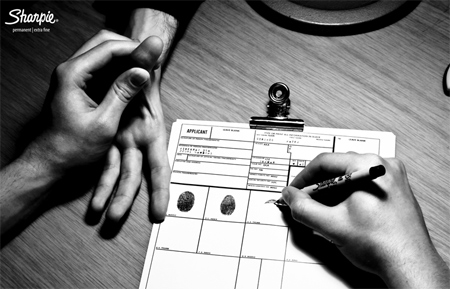
First of all, bring your attention to the color scheme. All around, a very gray atmosphere. Nothing too bright..... But what's this?!? A single paper gleams white against the pale gray surroundings. And on it are two dark blobs, contrasting against the bright paper that, in turn, contrasts against the desk. These two blobs are fresh fingerprints on a prison entrance form. However, these prints weren't made with the traditional stamp ink. Instead, they were made by a fine point Sharpie Permanent Marker, and a third is in the middle of being documented.
This simple act of criminal documentation provides a powerful assumption of how precise this Sharpie actually is. An ethos of this image is in the actual printed paper. I don't know much about other places, but I know that the United States treatment of criminals is extremely strict in what information they keep. The fact that a Sharpie would be used in the criminal justice system really speaks to its implied precision. This gives it a certain authority; the fact that the American Government would choose this method of documentation over any other is certainly a feat that not many others can boast of. Or, at least that's what they want you to think.
Another rhetorical device, logos, is placed into the image with the method of imprinting as well. While it is still impressive that one can write finely enough to document a fingerprint, there is still the fact that it is being sketched BY EYE. With no technological aid, one man has already sketched two fingerprints, and is currently fine copying a third! This level of expertise is assumed to have a direct correlation to the pen that the sketch artist is using. Can anyone draw this precisely just by using a Sharpie Permanent Marker? Can YOU!?!......Well, that's what they want you to think.
The final -os of today's analysis is the pathos of the image. While it's all fine and dandy that the pen and paper are the main focus of the image, a nifty little side-show is present just off to the left. See that hand? No, not the sketcher's hand, the other one. That hand is the hand of a convicted felon. This man has done something to earn him hard time in the slammer. Maybe he's killed men. Maybe he's slaughtered pedestrians. Maybe he's done both. But, all the same, there is a single writing utensil that is effectively putting this man behind bars, and that, my friends, is the Sharpie Permanent Marker. By supporting this marker, you are aiding in the fight against crime everywhere....... At least that's what they want you to think.
Thursday, August 25, 2011
The Power of Pictures
If you were to ask me what the most persuasive medium is, I'd probably tell you music. However, just because it is the most persuasive doesn't mean it is the most pervasive. While music will always have the most impact to me as a persuasive medium, simple images and pictures will be a part of our lives 24/7. While walking down a street, we are subjected to many stimuli in the form of images. Pictures, billboards, and store signs all jump out at us, and even at home, we fill our space with pictures and images that appeal to us individually. A simple color pallet can affect an entire room with complacency and a calming mood, while more complex portraits and murals can evoke powerful emotions such as happiness, joy, and sadness with such accuracy that it seems as though the artist knew how he wanted you to feel. It is the artist's purpose to instill these emotions within you.
When I watched the above video for the first time, the images were so powerful to me that I actually began to cry. The artist's purpose was startlingly clear, and the accuracy of the images was phenomenal. Shrouded in gray, the obscurity of the images was very realistic, as I do believe that this is what soldiers see on the front lines; a haze, and an inability to focus on the minute details of an event. This accuracy and purpose is what makes images so pervasive throughout our lives.
Subscribe to:
Posts (Atom)